
Key Takeaways
- ▲ Spacecoin is building a decentralized satellite internet network that uses blockchain-enabled low-Earth-orbit nanosatellites to extend connectivity beyond traditional towers and fiber.
- ▲ CoinGecko data showed SPACE near $0.00839, with market cap around $18.0 million, 24-hour volume near $15.8 million, and a 24-hour gain of roughly 23.6%.
- ■ Public data lists a 21 billion SPACE maximum supply and 2.1525 billion circulating tokens, making supply monitoring important as the network develops.
- ▼ SPACE is still a young DePIN asset, so long-term valuation depends on satellite deployment, pilot coverage, user demand, and exchange liquidity.

Spacecoin (SPACE) has moved into the market’s attention because it connects two strong narratives: decentralized physical infrastructure networks and global internet access. The project describes itself as a satellite-based decentralized internet network that aims to provide reliable, permissionless connectivity through blockchain-enabled low-Earth-orbit satellites.
The timing matters. The official Spacecoin website says the project targets people who remain unconnected and positions the network as a blockchain-powered DePIN for global 5G access. CoinGecko also classifies Spacecoin under Communication, Infrastructure, DePIN, Ethereum Ecosystem, BNB Chain Ecosystem, and Binance Alpha Spotlight categories.
What is Spacecoin (SPACE)?
Spacecoin is a crypto project focused on decentralized satellite internet. Its core idea is to use low-Earth-orbit nanosatellite constellations to transmit data without relying entirely on conventional infrastructure such as cell towers, fiber-optic cables, or country-specific internet gatekeepers. The official site calls Spacecoin the “world’s first DePIN powered by satellites,” while CoinGecko describes it as a satellite-based network designed to provide reliable, permissionless connectivity worldwide.
That makes SPACE different from many infrastructure tokens. Instead of only coordinating storage, compute, mapping, or wireless hotspots on the ground, Spacecoin is trying to extend DePIN into orbit. The project’s public messaging focuses on lifeline connectivity for underserved regions and censorship-resistant access where infrastructure is limited, expensive, or politically constrained.
CoinGecko lists Spacecoin’s asset platform as Ethereum, with the SPACE contract address shown on both Ethereum and BNB Chain as 0x87acfa3fd7a6e0d48677d070644d76905c2bdc00. That multichain visibility gives users more than one public explorer route for checking token data, including Etherscan and BscScan links listed by CoinGecko.
 Bybit 20% Fee Discount
Free Coinbix Premium Channel
How does Spacecoin work?
Spacecoin’s network concept has three layers: satellites in orbit, blockchain-based coordination, and user access on the ground. The official website says the project uses small LEO satellites to create a global 5G network. LEO satellites are closer to Earth than traditional geostationary satellites, which can support lower-latency communication and more flexible coverage when deployed as a constellation.
The second layer is blockchain coordination. Spacecoin states that blockchain technology powers transparent satellite operations and smart-contract-based management of network activity. The goal is to make connectivity more open and trustless, rather than requiring users to rely on one national telecom provider, one payment processor, or one centralized network operator.
The third layer is crypto-native payment access. Spacecoin says users can pay internet fees with on-chain assets, reducing friction for people in regions with limited banking infrastructure. The project also highlights Creditcoin integration, including a Universal Smart Contract layer, buy-now-pay-later internet fee options through Credal, and the possibility of building on-chain credit profiles through repeated network usage and payments.
What makes Spacecoin’s technology notable?
The project’s technology narrative is notable because it connects crypto incentives to a real-world infrastructure bottleneck. The official Spacecoin website cites 2.9 billion people who remain unconnected, while CoinGecko’s description references 2.6 billion people who have never connected to the internet and another 3.5 billion with restricted access. The exact framing differs by source, but the overall market problem is clear: internet access remains uneven.
Spacecoin’s proposed answer is physical decentralization. Its roadmap states that the first satellite, CTC-0, launched on SpaceX’s Bandwagon-2 rocket in 2024 for pilot testing with partners in Africa and South Asia. CoinGecko’s project description says the first satellite launched in December 2024, with three more planned for October 2025.
The roadmap also points to continued coverage expansion in 2026 and a future service that would allow users to launch their own satellites and join the network. If executed, that would make Spacecoin closer to an open infrastructure protocol than a closed satellite internet company.
Spacecoin tokenomics: What should holders know?
CoinGecko data showed Spacecoin with a maximum supply of 21,000,000,000 SPACE, total supply of 21,000,000,000 SPACE, and circulating supply of 2,152,500,000 SPACE at the time reviewed. The same CoinGecko snapshot showed a market capitalization near $18.0 million and a fully diluted valuation near $175.9 million.
Those numbers frame the difference between current market value and fully diluted value. With only a portion of maximum supply circulating, investors should monitor how future token releases are scheduled, how liquidity develops across exchanges, and whether network adoption grows quickly enough to support the larger supply base. That does not weaken the long-term thesis by itself, but it makes supply transparency central to any SPACE review.
CoinGecko lists SPACE on Ethereum and BNB Chain with 18 decimals. For users researching SPACE, the safest approach is to verify the contract address directly through CoinGecko or the project’s official channels before interacting with any token contract.
What are Spacecoin’s main use cases?
Spacecoin’s first use case is decentralized internet access. The project’s core promise is to help connect users in areas where traditional infrastructure is unavailable, unreliable, expensive, or heavily controlled. If Spacecoin can deliver low-cost lifeline connectivity, it could become relevant for remote communities, emerging markets, disaster recovery, and backup connectivity.
The second use case is crypto-based payment for connectivity. Spacecoin highlights borderless payment access through cryptocurrency, which may help users who do not have easy access to credit cards or conventional banking. This is one of the clearest overlaps between Spacecoin’s infrastructure thesis and blockchain utility.
The third use case is open infrastructure participation. The official roadmap says Spacecoin plans to prepare a service that enables users to launch their own satellites and join the network. The fourth is on-chain credit formation, where repeated payment history could help unbanked users build digital credit profiles through the Creditcoin-related ecosystem.
SPACE price analysis: Why is it moving?
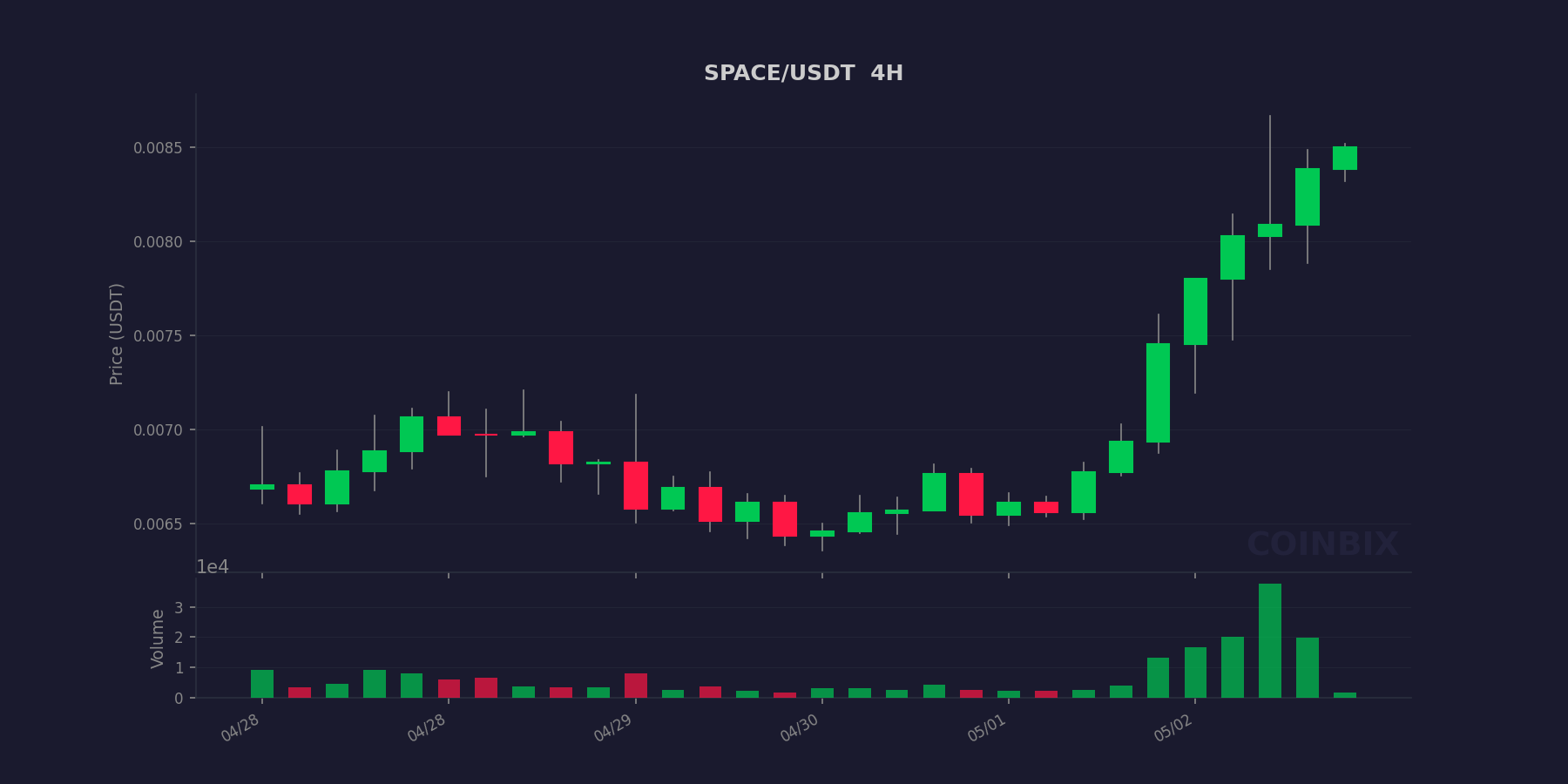
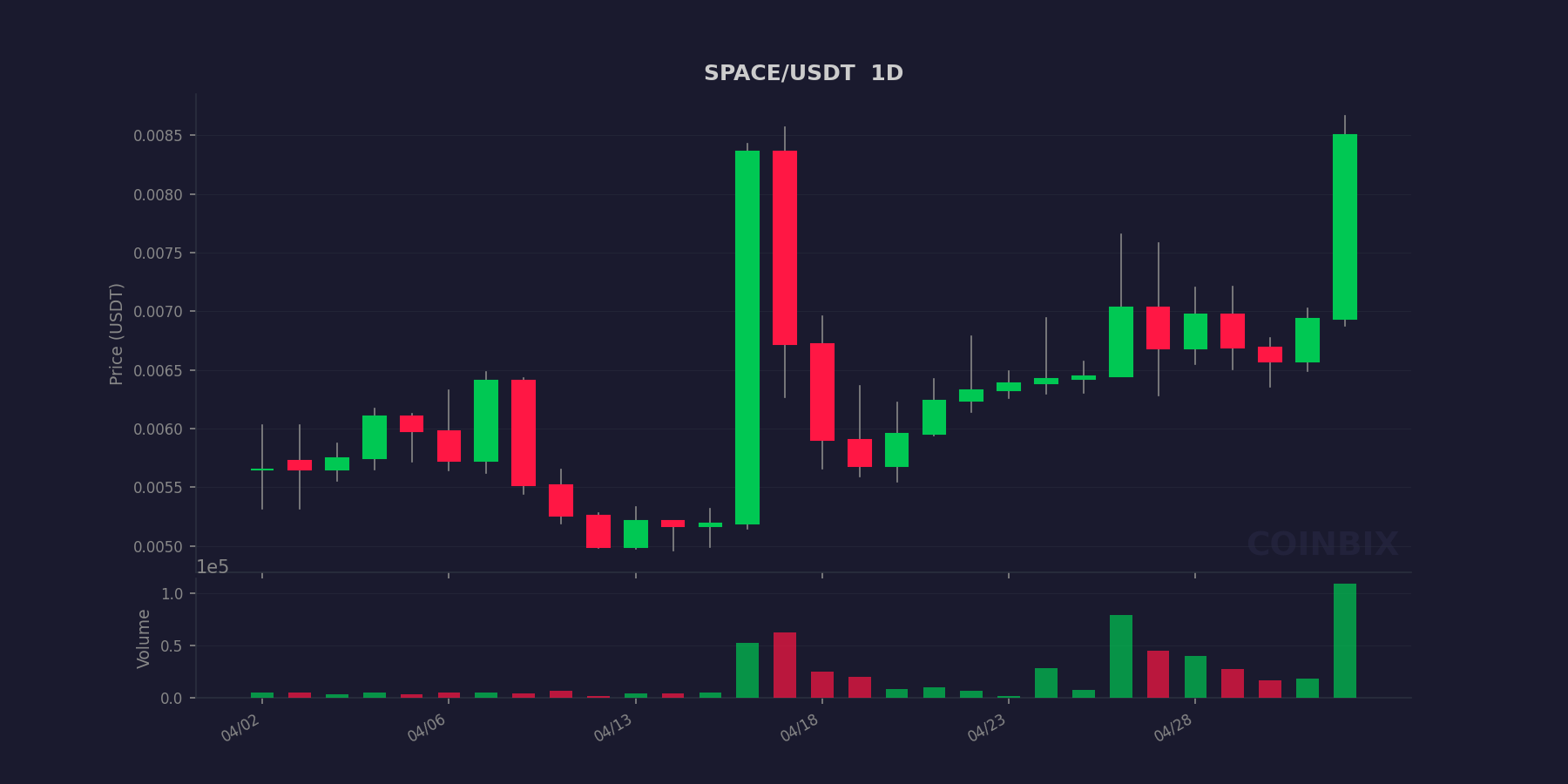
SPACE has gained attention because its market data shows strong recent momentum. The article brief cited CoinMarketCap trending rank #446 and a 24.9% price change. A live CoinGecko market snapshot reviewed for this article showed SPACE near $0.00839, up about 23.6% over 24 hours, with 24-hour volume near $15.8 million. CoinGecko also showed a seven-day gain of about 30.5% and a 30-day gain of about 50.5%.
That combination is constructive. A rising price with meaningful volume suggests the market is not only reacting to a small illiquid print. It also shows that investors are looking again at DePIN assets with tangible infrastructure stories. Spacecoin’s satellite internet positioning gives the token a differentiated theme compared with general Layer 1, meme, or AI-token narratives.
At the same time, the chart still reflects a young asset. CoinGecko listed SPACE’s all-time high at $0.02603 on January 23, 2026, meaning the token remained roughly 67.5% below that peak at the reviewed price. CoinGecko also listed an all-time low near $0.00413 on February 9, 2026, placing the reviewed price more than 100% above that low.
For a balanced but positive outlook, that structure is encouraging. SPACE has recovered meaningfully from its low, remains well below its high, and has a project narrative that can attract DePIN-focused attention if execution milestones continue. A constructive scenario would see the token hold higher lows on the 4-hour chart and keep liquidity active around the SPACEUSDT market.
How to buy Spacecoin (SPACE) on Bybit
Users who want exposure to SPACE should begin by checking Bybit’s current SPACE market availability, supported networks, and deposit rules inside the exchange interface. Exchange listings, supported pairs, and network options can change, so the safest first step is to search for SPACE or SPACEUSDT directly on Bybit and confirm that the asset details match the official Spacecoin contract information from public sources such as CoinGecko.
A typical Bybit purchase flow is simple. First, create or log in to a Bybit account and complete the required identity and security steps. Second, deposit USDT or another supported funding asset. Third, open the spot market search and look for SPACE/USDT if available. Fourth, choose a limit order for price control or a market order for immediate execution. Finally, review the filled order, confirm balances, and decide whether to keep tokens on the exchange or withdraw to a compatible wallet after verifying network support.
Because SPACE is associated with Ethereum and BNB Chain on CoinGecko, users should be especially careful with withdrawal networks. Sending tokens to the wrong chain or an unsupported address can lead to permanent loss. The positive side is that public explorer data makes verification easier before moving larger amounts.
Spacecoin outlook: What could support the next phase?
Spacecoin’s outlook is positive because it sits at the intersection of three powerful themes: DePIN, global connectivity, and crypto-native payments. The project is not trying to create demand from scratch. Internet access is already essential, and underserved connectivity remains a large global problem. If Spacecoin can lower access costs and make participation more open, the utility case for SPACE becomes easier for the market to understand.
Several catalysts could support the next phase. The first is satellite deployment progress, especially updates tied to additional launches or pilot coverage. The second is clearer service availability in target regions. CoinGecko’s description names Nigeria, Indonesia, and India as target countries, with planned service pricing as low as $1-2 per month per user. The third is exchange liquidity, because deeper markets make it easier for new users and investors to enter without excessive slippage.
The fourth catalyst is ecosystem integration. Spacecoin’s official website emphasizes Creditcoin, Universal Smart Contracts, and on-chain credit. If those pieces become visible in real user flows, SPACE could develop a stronger utility narrative than many early-stage infrastructure tokens. The main variable is execution speed, but Spacecoin has a clear story, public token data, and a strong DePIN angle.
Bybit 20% Fee Discount
Free Coinbix Premium Channel
FAQ
What is Spacecoin (SPACE)?
Spacecoin is a decentralized satellite internet project. It aims to use blockchain-enabled low-Earth-orbit nanosatellites, crypto payments, and open infrastructure participation to provide more reliable and permissionless connectivity worldwide.
What does the SPACE token do?
SPACE is the project’s crypto asset. Public sources describe Spacecoin as a DePIN network where blockchain can support payments, network coordination, and transparent infrastructure operations. Investors should follow official updates for final token utility details.
What is Spacecoin’s supply?
CoinGecko listed SPACE with a maximum supply of 21 billion tokens, total supply of 21 billion tokens, and circulating supply of 2.1525 billion tokens at the time reviewed. Supply changes should be checked through updated public data.
Why is SPACE moving today?
SPACE was moving after strong market momentum, with the article brief citing a 24.9% gain and CoinGecko showing about a 23.6% 24-hour increase near the reviewed snapshot. Interest in DePIN and satellite connectivity likely helped the market narrative.
Where can users verify Spacecoin data?
Users can verify project claims through the official Spacecoin website, CoinGecko’s Spacecoin page, CoinMarketCap’s SPACE listing, and public blockchain explorers such as Etherscan or BscScan for the listed contract address.
Affiliate Disclosure: This page contains affiliate links. Coinbix may earn a commission at no extra cost to you.
Disclaimer: This article is for informational purposes only and does not constitute financial advice. Cryptocurrency investments carry significant risk. Always conduct your own research before making investment decisions.