
- ▲ BLESS token has surged 219.75% over the past 7 days and 217.30% over the past month
- ▲ Bless Network transforms idle devices into a global shared supercomputer for AI applications
- ▲ Over 5 million nodes participated in testnet, demonstrating massive network adoption
- ■ Total supply of 10 billion BLESS with only 18% currently in circulation
- ▲ Node operators receive 90% of service revenue, creating strong incentive alignment
- ■ Listed on 29 exchanges including Kraken, Gate, Binance Futures, Bybit, and Bitget
The rise of artificial intelligence has created an unprecedented demand for computing power. While tech giants race to build massive data centers, one project is taking a radically different approach. Bless (BLESS) is building a decentralized computing network that harnesses the unused processing power of billions of devices worldwide, creating what they call a “shared computer for the AI era.” With the BLESS token gaining 219.75% over the past week alone, investors and tech enthusiasts are taking notice of this ambitious infrastructure play.
What is Bless (BLESS)?
Bless, formerly known as Blockless, is a decentralized computing platform founded in 2022 in San Francisco by Butian Li, Michael Chen, and Liam Zhang. The project aims to democratize access to computational resources by creating a global network where anyone can contribute their idle device capacity and earn rewards.
At its core, Bless addresses a fundamental inefficiency in modern computing: the vast majority of devices sit idle for most of the day. Your smartphone, laptop, or desktop computer likely uses less than 20% of its processing capacity during typical usage. Bless aggregates these underutilized resources into a powerful, distributed supercomputer that can handle everything from AI inference to complex data processing tasks.
The project raised $8 million in funding across two rounds, with NGC Ventures leading the $3 million pre-seed round and M31 Capital and Frachtis co-leading the $5 million seed round. This institutional backing has helped Bless develop its technology and expand its network to over 5 million testnet nodes.
How Does Bless Network’s Core Technology Work?
Bless operates on a multi-chain architecture, with its BLESS token available as an ERC20 token while also running on its native BlessNet blockchain. The network uses a Proof of Stake consensus mechanism and incorporates several innovative technologies to ensure security, efficiency, and scalability.
What is the nnApp Architecture?
The nnApp (neural network application) architecture is Bless’s proprietary framework for deploying and executing distributed applications. Unlike traditional cloud computing where applications run on centralized servers, nnApps are broken into smaller components that execute across the network of participating nodes.
This architecture enables Bless to handle complex AI workloads that would typically require expensive GPU clusters. By distributing tasks across thousands of consumer devices, nnApps can achieve comparable performance at a fraction of the cost while maintaining redundancy and fault tolerance.
How Does the WASM Security Runtime Protect Users?
Security is paramount when executing code on strangers’ devices. Bless uses WebAssembly (WASM) as its execution environment, providing a sandboxed runtime that isolates network tasks from the host device’s operating system and personal data.
WASM ensures that code running on your device cannot access your files, browsing history, or other sensitive information. This sandboxing technology, originally developed for web browsers, has become the industry standard for secure, portable code execution across different platforms and architectures.
What is Dynamic Resource Matching?
Not all computing tasks are created equal, and neither are the devices in the Bless network. Dynamic Resource Matching is Bless’s intelligent allocation system that pairs tasks with the most suitable available nodes based on their hardware capabilities, current load, and network conditions.
This system uses a Greco-Latin square-based random distribution algorithm to ensure fair task allocation while preventing any single node from becoming a bottleneck. The result is efficient utilization of the network’s diverse computing resources, from high-end gaming PCs to modest smartphones.
How Does ZKP-Based Verification Ensure Integrity?
When computation is distributed across thousands of untrusted nodes, verifying the correctness of results becomes critical. Bless employs Zero-Knowledge Proofs (ZKPs) to verify that nodes have correctly executed their assigned tasks without requiring redundant computation.
Dynamic Verification takes this a step further by sampling and validating a subset of results in real-time. This approach provides cryptographic guarantees of correctness while maintaining the network’s efficiency and cost-effectiveness.
What Products Does Bless AI Offer?
Bless has developed two flagship product lines that leverage its decentralized infrastructure: Bless AI and Bless Compute. These products demonstrate the practical applications of the network’s capabilities.
How Does AI Answer Verification Work?
One of the most compelling use cases for Bless’s network is verifying AI-generated responses. As large language models become ubiquitous, the need to validate their outputs grows increasingly important. Bless AI uses multiple independent models to cross-check answers, identifying potential hallucinations or errors through consensus.
This verification process runs on the distributed Bless network, making it significantly more cost-effective than running multiple instances of large models on centralized cloud infrastructure. The result is reliable AI validation at a fraction of the typical cost.
What Are Context and Identity Controls?
Bless AI also provides sophisticated controls for managing AI interactions. Users can define specific contexts that constrain how AI models respond, ensuring outputs remain relevant and appropriate for specific use cases.
Identity controls allow for verified, attributable AI interactions, which is crucial for applications where accountability matters. These features make Bless AI particularly valuable for enterprise customers who need reliable, controllable AI systems.
What is Bless Compute?
Bless Compute is the platform’s general-purpose computing marketplace. It allows anyone with spare CPU cycles, memory, or storage to contribute to the network and earn BLESS tokens in return. The platform is designed to be accessible to non-technical users, with simple setup processes for most devices.
According to Bless Network’s official documentation, node operators receive 90% of the revenue generated from services running on their hardware. This generous revenue share has helped attract over 5 million nodes to the testnet, demonstrating strong community interest and participation.
Compute buyers benefit from prices significantly lower than traditional cloud providers while gaining access to a globally distributed infrastructure that offers lower latency and better resilience against outages.
What is the BLESS Token Economics Model?
Understanding the token economics is essential for evaluating any cryptocurrency project. BLESS has a clearly defined supply structure and utility within the network ecosystem.
What is the Token Supply and Distribution?
BLESS has a total supply of 10 billion tokens, with approximately 1.84 billion (18%) currently in circulation. This means the majority of tokens remain locked or unreleased, which has important implications for future supply dynamics.
The token serves multiple functions within the ecosystem: it is used to pay for computing services, stake as a node operator, and participate in network governance decisions. This utility creates natural demand as the network grows and more users require computational resources.
How Do Staking and Rewards Work?
Node operators must stake BLESS tokens to participate in the network and earn rewards. This staking mechanism serves two purposes: it aligns operator incentives with network health, and it creates additional demand for the token.
Rewards are distributed based on the quality and quantity of computational resources provided. The 90% revenue share for operators is significantly higher than most competing platforms, making Bless an attractive option for those looking to monetize idle hardware.
What is the Current BLESS Price and Market Status?
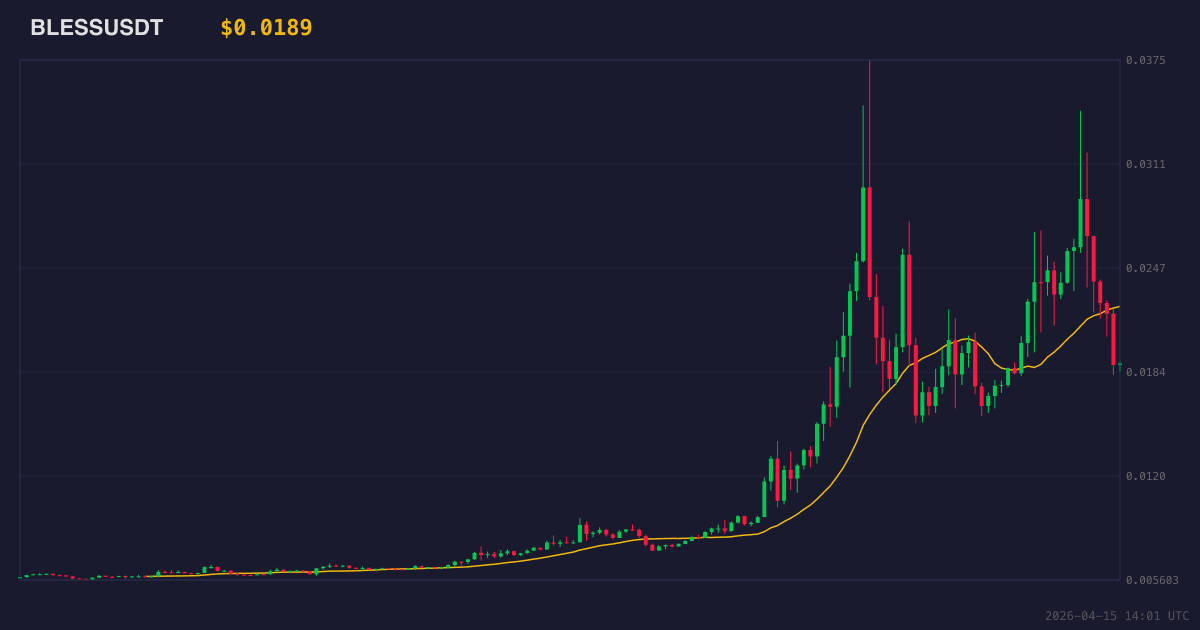
As of April 15, 2026, BLESS is trading at approximately $0.01858, representing a 60.5% increase in the past 24 hours, according to CoinGecko data. The token currently ranks #5 on CoinGecko’s trending list, indicating significant market attention.
What is the Price History of BLESS?
BLESS reached its all-time high of $0.2201 on October 15, 2025, shortly after its exchange listings began. The token then experienced a prolonged decline, hitting an all-time low of $0.004112 on February 28, 2026—a drop of over 98% from its peak.
The current recovery represents a remarkable turnaround. With gains of 219.75% over 7 days and 217.30% over 30 days, BLESS has more than tripled in value from its lows. However, it remains approximately 91% below its all-time high, suggesting significant room for recovery if the project continues to execute on its roadmap.
What Are the Trading Volume and Market Cap?
BLESS currently has a market capitalization of approximately $34.22 million, with a fully diluted valuation of $185.84 million. The 24-hour trading volume has reached approximately $289 million, representing a volume-to-market cap ratio of over 8:1.
This high trading volume relative to market cap indicates strong speculative interest and liquidity. The token is listed on 29 exchanges including major platforms like Kraken, Gate, Binance Futures, Bybit, and Bitget, providing multiple avenues for trading.
How Can You Participate in the Bless Network?
There are two primary ways to engage with the Bless ecosystem: as a compute provider (node operator) or as a compute buyer.
To become a node operator, users can download the Bless client software from the official website and run it on compatible devices. The software automatically manages task allocation, execution, and reward distribution. Most modern Windows, macOS, and Linux devices are supported, with mobile applications also available.
For those interested in purchasing compute resources, Bless offers APIs and SDKs that integrate with existing applications. The platform supports a variety of workloads including AI inference, data processing, and distributed computing tasks.
Token holders can also stake their BLESS to support network security and earn additional rewards, though specific staking requirements and returns vary based on network conditions.
How Does Bless Compare to Competing Projects?
The decentralized computing space has several established players, most notably Render Network (RENDER) and io.net. For readers exploring other trending AI-era tokens, see our reviews of RaveDAO (RAVE) and Enjin Coin (ENJ). Each project takes a slightly different approach to distributed computing.
Render Network focuses primarily on GPU rendering for visual effects and AI, with a strong emphasis on high-end graphics processing. io.net specializes in aggregating GPU resources specifically for AI and machine learning workloads, targeting enterprise customers with demanding computational needs.
Bless differentiates itself through its focus on general-purpose computing and accessibility. While competitors often require specialized hardware, Bless can utilize almost any modern device, from smartphones to data center servers. The nnApp architecture also enables more flexible application deployment compared to the narrower focus of rendering or AI-specific platforms.
The 90% revenue share for node operators is also notably higher than many competitors, potentially giving Bless an advantage in attracting and retaining network participants.
Frequently Asked Questions
Is Bless (BLESS) a good investment?
BLESS has demonstrated significant recent price appreciation with 219% gains over the past week. However, the token remains 91% below its all-time high, indicating substantial volatility. The project’s fundamentals—including 5 million+ testnet nodes, $8 million in funding, and real-world utility—provide some basis for optimism. As with any cryptocurrency investment, thorough research and risk management are essential.
What makes Bless different from other decentralized computing projects?
Bless distinguishes itself through its nnApp architecture, which enables general-purpose distributed computing rather than focusing solely on rendering or AI. The platform can utilize virtually any modern device, making participation accessible to a broader audience. Additionally, the 90% revenue share for node operators is among the highest in the industry.
How can I earn BLESS tokens?
You can earn BLESS tokens by operating a node on the Bless Network, contributing your device’s idle computing resources to the network. The Bless client software handles task execution automatically, and rewards are distributed based on the quantity and quality of resources provided. Tokens can also be acquired through exchanges where BLESS is listed.
What is the total supply of BLESS tokens?
BLESS has a total supply of 10 billion tokens. Currently, approximately 1.84 billion tokens (18%) are in circulation, with the remainder locked or yet to be released. This supply structure should be considered when evaluating the token’s market dynamics and potential future inflation.
Which exchanges list BLESS tokens?
BLESS is available on 29 exchanges including Kraken, Gate.io, Binance Futures, Bybit, and Bitget. The token has significant trading volume across these platforms, with approximately $289 million in 24-hour trading activity as of April 2026.
What are the main risks of investing in Bless?
Key risks include the highly competitive nature of the decentralized computing sector, the significant token unlocks that may occur as more of the supply enters circulation, and the inherent volatility of cryptocurrency markets. Additionally, the project’s success depends on attracting and retaining both compute providers and buyers in a competitive market.
Conclusion
Bless represents an ambitious attempt to democratize access to computing power by harnessing the world’s idle devices. With over 5 million testnet nodes, $8 million in institutional funding, and a unique technical approach through its nnApp architecture, the project has established credible foundations.
The recent surge in BLESS token price reflects growing market recognition of decentralized computing’s potential. However, investors should remain aware of the significant volatility demonstrated by the token’s 98% drawdown from all-time highs and the substantial portion of supply yet to enter circulation.
As AI continues to drive demand for computational resources, projects like Bless that can provide cost-effective, distributed alternatives to centralized cloud providers may find significant market opportunities. The coming years will reveal whether Bless can translate its technical vision into sustainable network adoption and token value appreciation.
Affiliate Disclosure: This page contains affiliate links. Coinbix may earn a commission at no extra cost to you.
Disclaimer: This article is for informational purposes only and does not constitute financial advice. Cryptocurrency investments carry significant risk. Always conduct your own research before making investment decisions.