

- ▲ Aerodrome Finance is positioned as Base’s central liquidity hub, combining token swaps, liquidity incentives, and vote-lock governance through Aerodrome Finance.
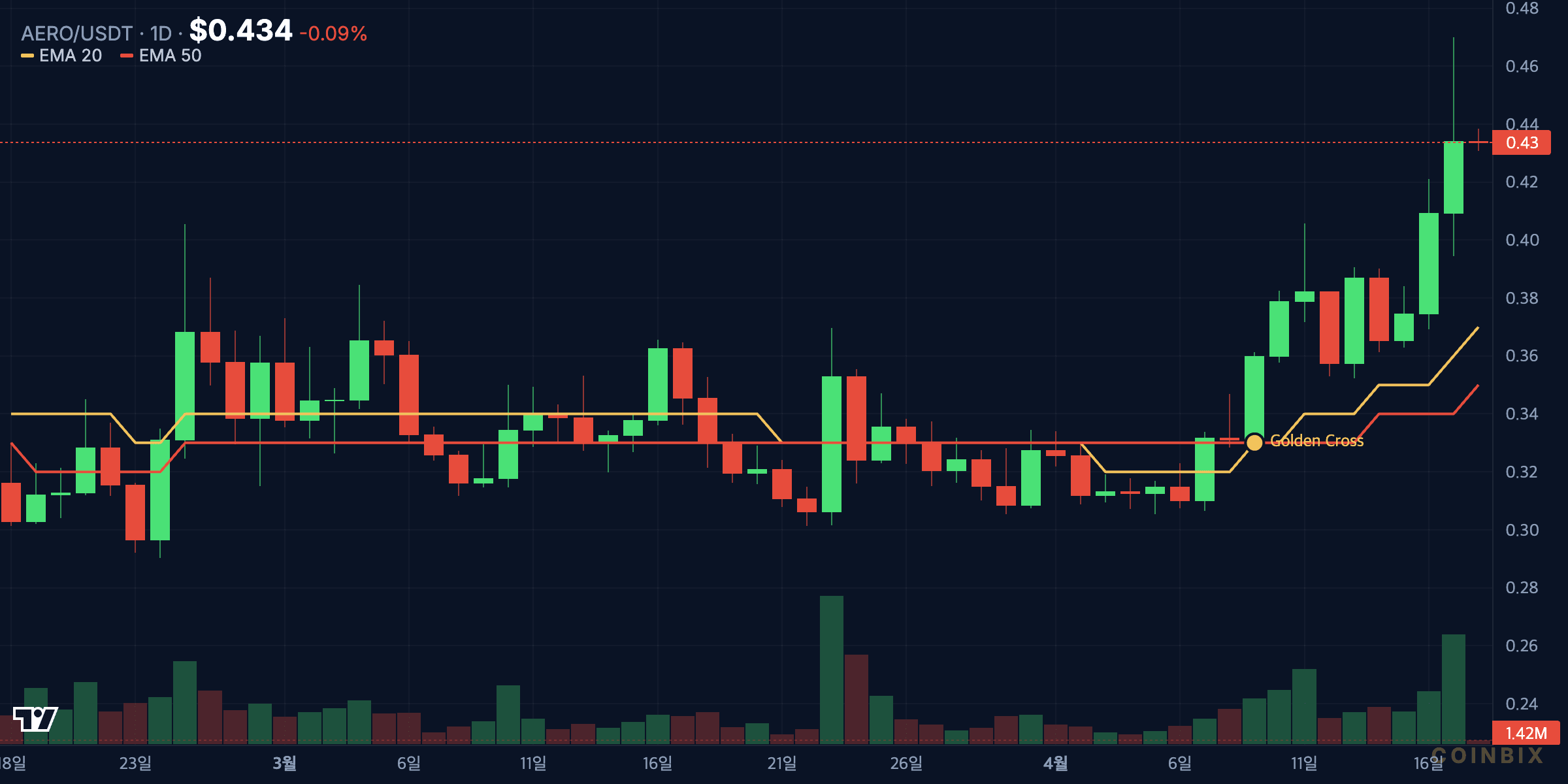
- ▲ CoinGecko data on April 18, 2026 showed AERO at about $0.4349, up 8.8% in 24 hours, 15.8% in 7 days, and 31.7% in 30 days.
- ▲ The protocol’s design routes 100% of value to liquidity providers and veAERO participants, while veAERO voters direct weekly emissions and receive fees plus incentives.
- ▲ Aerodrome launched on Base on August 28, 2023, and supports stable, volatile, and concentrated liquidity pools for different trading conditions.
- ■ AERO’s market cap was about $401.2 million, with 24-hour trading volume near $46.4 million and circulating supply near 922.3 million tokens, according to CoinGecko.
Related reviews: What is Pippin (PIPPIN)? Overview & Price Outlook and What is Bio Protocol (BIO)? Overview & Price Outlook.
Aerodrome Finance has become one of the clearest ways to track the growth of DeFi on Base. When a protocol aims to be the chain’s main liquidity venue, investors are not only buying into a token, they are evaluating whether that exchange layer can keep attracting traders, liquidity providers, and protocol partners. That is why AERO’s recent strength matters now. Price momentum has improved, the token has regained attention after a difficult pullback from its 2024 peak, and the underlying protocol still offers a structure that is easy to map to real on-chain activity: swaps, fees, emissions, and governance.

What is Aerodrome Finance (AERO)?
Aerodrome Finance is a decentralized exchange and automated market maker built on Base. In its own documentation, the project describes itself as a next-generation AMM designed to serve as Base’s central liquidity hub, combining a liquidity incentive engine, vote-lock governance model, and user-friendly experience. The protocol also states that it inherits the latest features from Velodrome V2, which helps explain why its design feels optimized for both trader efficiency and long-term token participation.
At the highest level, Aerodrome tries to solve a simple but important DeFi problem. Every chain needs deep liquidity so traders can swap tokens with low slippage, new protocols can bootstrap markets, and stablecoin pairs can operate efficiently. Aerodrome approaches that problem by using different pool types for different assets, then layering token incentives and governance on top so liquidity can be directed where the market needs it most.
That makes Aerodrome more than a standard DEX. It is an infrastructure play on Base activity. If Base keeps growing as a DeFi ecosystem, a protocol that captures swap activity and coordinates emissions could stay central to that expansion.
For readers who want the primary source, Aerodrome’s official help documentation explains the model across its introduction, liquidity pools guide, and tokenomics page.
How does Aerodrome work as a liquidity hub?
The protocol organizes liquidity into several pool types. According to Aerodrome’s documentation, stable pools are designed for correlated assets such as stablecoins, while volatile pools are designed for assets with higher price volatility. Aerodrome also supports concentrated liquidity pools, where liquidity is deployed within a specific price range using tick spacing. That gives the protocol flexibility across the most common trading conditions on Base.
The router is designed to evaluate available pool types to find the most efficient route for a swap, and the documentation says it uses 30-minute time-weighted average prices to help protect against flash-loan attacks. From an investor perspective, that matters because a liquidity hub only becomes sticky when traders can consistently access reliable execution and low slippage.
The protocol’s economics add another layer. Aerodrome states that only staked liquidity in gauges receives AERO emissions. Those emissions are not distributed randomly. Instead, veAERO voters determine which pools receive them each epoch. That creates a loop where liquidity providers, token lockers, and partner protocols all have incentives to coordinate around active markets.
This structure is one reason Aerodrome has stood out inside the Base ecosystem. It turns liquidity from a passive pool into a governed marketplace, where capital allocation decisions can be influenced every week.
What are AERO and veAERO?
Aerodrome uses a two-token system in practice, although only AERO trades as the liquid market token. The documentation describes AERO as the ERC-20 utility token of the protocol and veAERO as the ERC-721 governance token represented by a vote-escrow NFT. Any AERO holder can lock tokens and receive veAERO in exchange.
The lock design is straightforward but powerful. Locking for longer periods creates more voting power. Aerodrome’s tokenomics page gives a simple illustration: 100 AERO locked for four years becomes 100 veAERO, while 100 AERO locked for one year becomes 25 veAERO. The protocol also offers an auto-max-lock feature that treats a position as locked for the maximum duration, which prevents voting power decay while that setting remains enabled.
Why does this matter for price outlook? Because vote-escrow models can reduce liquid supply and reward long-term alignment. Instead of every token holder simply waiting for price appreciation, Aerodrome encourages participants to lock AERO to direct emissions, capture fees, and collect outside incentives. That tends to support deeper ecosystem engagement than a token with no clear utility beyond speculation.
The project also emphasizes that its economy is designed as a zero-leak system in which value is distributed to contributors, especially liquidity providers and veAERO operators. In practical terms, that means the token is linked to protocol activity instead of being purely narrative-driven.
Why is Aerodrome Finance moving higher?
The most immediate reason is market momentum. CoinGecko data retrieved on April 18, 2026 showed AERO at about $0.4349, up 8.8% over 24 hours, 15.8% over 7 days, and 31.7% over 30 days. Bybit spot ticker data at roughly the same time showed AERO/USDT trading around $0.4344 with more than $5.8 million in quoted volume on that venue alone. That kind of multi-week recovery is notable because it suggests buyers are returning after a long period of price compression.
The second reason is structural. Aerodrome still occupies a clear role inside Base DeFi. Protocols that control liquidity routing and emissions often benefit from network effects. More trading activity can mean more fees, more reasons for protocols to incentivize votes, and more relevance for veAERO positions. That feedback loop does not guarantee upside, but it does give AERO a concrete utility story.
The third reason is token design. Aerodrome’s emissions system is detailed enough that the market can form expectations around supply growth. The official emissions page states that AERO launched with an initial supply of 500 million, with 450 million distributed as veAERO. Weekly emissions began at 10 million AERO and moved through planned phases called Take-off, Cruise, and Aero Fed. Under Aero Fed, veAERO holders can collectively vote to increase, decrease, or maintain emissions as a share of total supply. That is an unusually explicit monetary framework for a DeFi token, and markets often reward tokens when supply governance is transparent.
There is also a recovery angle. CoinGecko shows AERO remains well below its all-time high of $2.32 from December 7, 2024. At the current level near $0.43, the token is still trading at a steep discount to that peak. For bullish investors, that creates room for a rerating if Base activity, protocol fees, and emission governance continue to mature.
Tokenomics and emissions that support the bull case
Aerodrome’s tokenomics are one of the stronger parts of the project. According to the official documentation, the initial 500 million AERO supply was divided between 50 million liquid AERO and 450 million vote-locked veAERO. The listed initial distribution included 40 million AERO for voter incentives, 10 million for genesis liquidity incentives, 200 million veAERO for veVELO lockers, 105 million auto-max-locked for a public goods fund, 95 million auto-max-locked for development team funding, and 50 million auto-max-locked for Flight School.
That launch structure matters because it pushed a large share of supply into locked governance positions from day one. Even though total supply has expanded since launch, the protocol did not begin as a simple high-float token with no commitment mechanism. It started with a design that prioritized governance, alignment, and ecosystem growth.
The emissions framework is also more nuanced than it first appears. Aerodrome says the first 14 weeks were a Take-off phase, with emissions increasing by 3% each week to accelerate growth and onboarding. After that, emissions entered a Cruise phase, decaying by 1% per epoch. Once emissions fall below 9 million AERO per epoch, the Aero Fed mechanism lets veAERO voters set monetary policy within defined upper and lower bounds. This gives the system a path from bootstrapped growth toward community-controlled issuance.
Another positive feature is the rebase model. The documentation states that veAERO holders receive a rebase proportional to weekly emissions and the ratio of veAERO supply to AERO supply, helping reduce vote power dilution. In other words, Aerodrome does not only reward lockers with voting rights. It also adds a mechanism intended to keep long-term participants economically relevant.
For a review article, the key conclusion is simple: AERO is not just a reward token. It sits inside a fairly sophisticated emissions, locking, and governance design that encourages ongoing participation rather than short-term farming alone.
How strong is AERO’s current market position?
Based on CoinGecko data from April 18, 2026, AERO’s market capitalization stood near $401.2 million, while fully diluted valuation was about $817.8 million. Circulating supply was roughly 922.3 million tokens against total supply of about 1.88 billion. Daily trading volume was near $46.4 million. Those numbers place Aerodrome in a meaningful mid-cap zone: large enough to signal established relevance, but still small enough that further ecosystem growth could materially change the valuation profile.
The market cap-to-volume relationship also looks constructive. Daily turnover above $46 million against a $401 million market cap suggests the token still has healthy trading interest. For investors, that matters because liquidity often becomes a limiting factor for smaller DeFi tokens. AERO has moved beyond that early-stage issue.
Sentiment indicators from CoinGecko were also favorable, with roughly 81.25% positive user votes. Sentiment metrics should never be treated as primary evidence, but they do help confirm that the market currently views Aerodrome as a relatively strong Base-native DeFi name rather than a forgotten governance token.
Most importantly, the protocol still has a clear narrative fit. Base needs deep liquidity, and Aerodrome was explicitly built to fill that role. Investors often overcomplicate token analysis, but one of the best bullish signals is when a project’s product purpose remains easy to explain in one sentence. Aerodrome passes that test.
How to buy AERO on Bybit
AERO is available on Bybit spot markets through the AERO/USDT pair. CoinGecko’s ticker data listed Bybit as one of the active venues for the token, and the pair can be accessed through Bybit spot trading.
- Step 1: Create or log in to a verified Bybit account.
- Step 2: Deposit USDT or another supported funding asset.
- Step 3: Search for the AERO/USDT spot pair and review recent price action and liquidity.
- Step 4: Choose a market order for immediate execution or a limit order if you want a specific entry price.
- Step 5: After purchase, decide whether to keep AERO liquid for trading or move into the Aerodrome ecosystem if you plan to lock tokens and participate in governance.
For long-term users, the more interesting decision is often what happens after the buy. Aerodrome is built to reward active participation. Investors who want full exposure to the protocol thesis may prefer to study locking, voting, and liquidity provisioning rather than treating AERO as a passive hold only.
Price outlook: why the long-term setup still looks positive
The bullish case for AERO rests on three pillars. First, Aerodrome has a clearly defined product-market role inside Base. Second, the token captures meaningful utility through emissions, vote-locking, and fee participation. Third, the market is already showing renewed momentum, with strong 7-day and 30-day gains into April 18, 2026.
From a valuation perspective, the large gap between the current price and the prior all-time high leaves room for upside if sentiment toward Base DeFi stays constructive. The fully diluted valuation near $817.8 million is not trivial, but it also is not excessive for a protocol trying to anchor liquidity on a major Ethereum Layer 2. If Aerodrome keeps strengthening its position with traders, LPs, and partner protocols, the market can justify a higher multiple than it does during weak-cycle conditions.
The governance model also supports the positive outlook. veAERO voters do not simply vote for symbolic proposals. They control emissions allocation, receive 100% of trading fees and bribes on the pools they support, and operate within a weekly epoch rhythm that keeps the token economically active. That kind of repeated utility can help AERO maintain relevance even when broad market narratives rotate.
Just as important, Aerodrome’s documentation shows deliberate attention to pool design and capital efficiency. Stable, volatile, and concentrated liquidity structures make the protocol adaptable across different market environments. That adaptability is a strength because Base will likely keep onboarding a mix of stablecoin, blue-chip, and emerging token liquidity over time.
Overall, Aerodrome Finance looks like one of the stronger infrastructure-style DeFi tokens on Base. The current price action already reflects improving sentiment, but the bigger attraction is that the protocol still appears built for long-duration participation. For investors looking for a Base-native liquidity thesis, AERO remains one of the more compelling names to watch.
FAQ
What is Aerodrome Finance used for?
Aerodrome Finance is a decentralized exchange and liquidity hub on Base. It is used for token swaps, liquidity provision, emissions-based incentives, and vote-locked governance through veAERO.
What is the difference between AERO and veAERO?
AERO is the liquid ERC-20 utility token, while veAERO is the governance NFT received by locking AERO. veAERO holders vote on emissions and receive trading fees and incentives tied to their voting activity.
Why has AERO been rising recently?
As of April 18, 2026, CoinGecko data showed AERO up 8.8% in 24 hours, 15.8% in 7 days, and 31.7% in 30 days. The move likely reflects renewed interest in Base DeFi and Aerodrome’s continued role as a core liquidity venue.
Who benefits most from Aerodrome Finance?
No. Traders use the protocol for swaps, but liquidity providers can stake positions for emissions, and long-term holders can lock AERO into veAERO to participate in governance and fee capture.
What supports Aerodrome’s positive price outlook?
The positive case is supported by Aerodrome’s central role on Base, its active token utility, transparent emissions framework, and the fact that AERO still trades far below its 2024 all-time high while current momentum has improved.
 Bybit 20% Fee Discount
Free Coinbix Premium Channel
Affiliate Disclosure: This page contains affiliate links. Coinbix may earn a commission at no extra cost to you.
Disclaimer: This article is for informational purposes only and does not constitute financial advice. Cryptocurrency investments carry significant risk. Always conduct your own research before making investment decisions.